


CONSPIRACY TO COMMIT MASS MURDER

Updated: Aug 6
Dublin and Monaghan Car Bombs, 17 May 1974

South Leinster Street Two Women Killed
The deadliest day of the Troubles. More than half a century of unanswered questions.A former senior detective follows the evidence, challenges accepted explanations and asks why the full truth remains out of reach.

THE STORY
What Happened - and Why It Still Matters
On Friday, 17 May 1974, three car bombs exploded in central Dublin within minutes of one another. A fourth exploded in Monaghan ninety minutes later. Thirty-four people, including an unborn child, were killed and almost 300 were injured. It was the greatest loss of life on a single day of the Troubles. No one has ever been prosecuted.
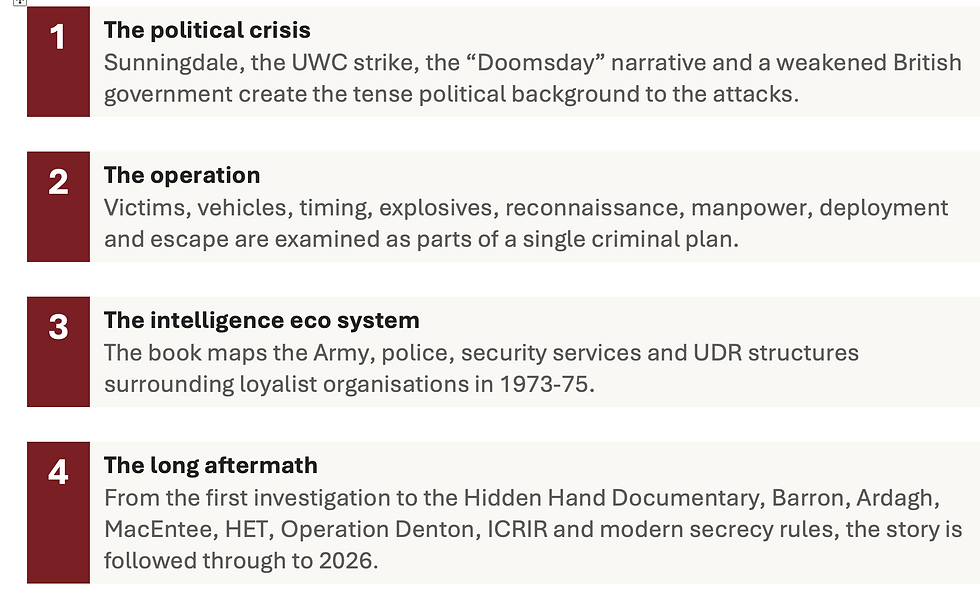
Conspiracy to Commit Mass Murder begins with the victims and the lived reality of the attacks, drawing on eyewitness testimony from Garda officers, survivors and those who encountered the immediate aftermath. It then widens the lens to the collapse of Sunningdale, the Ulster Workers’ Council strike, loyalist mobilisation, the UVF’s operational record, British and Irish security capacity, and the network of military, police and intelligence bodies operating in Northern Ireland.
This is not a book built on accusation. It follows the habits of a criminal investigation - motive, opportunity, means, capability, relationships, intelligence and conduct after the crime. Its central argument is both factual and moral: governments may manage political risk, but the murder of civilians creates an enduring duty to pursue the fullest truth that can still be found.
“This is not an assertion in search of supporting facts. It is an examination of the facts, the contradictions and the absences that have accumulated over five decades.” FROM THE PROLOGUE |

The questions at the heart of the book
· Could the UVF, acting alone, have organised and executed the highly coordinated Dublin operation?
· What did the British Army, RUC Special Branch, MI5, MI6, the UDR and their informant networks know before and after the attacks?
· Why did intelligence identifying suspects fail to produce transparent investigation, disclosure or prosecution?
· Did British secrecy and Irish governmental caution combine to prevent full accountability?
How the story unfolds

A powerful organising idea: “Operation Deny”
The book uses Operation Deny as an analytical description - not the name of a formally declared operation - for a recurring British Paradigm: establish an early official account; protect sensitive institutions; narrow the evidence; resist disclosure; prolong proceedings; and concede only what has escaped, because of later inquiry, litigation or public pressure makes unavoidable. The pattern is examined through Ballymurphy, McGurk’s Bar, Bloody Sunday, Dublin and Monaghan, the Miami Showband massacre and the Reavey murders.
What the investigation draws upon
· Official records, parliamentary proceedings, inquiry reports, court judgments and contemporary intelligence material.
· Professional assessments from experienced British and Irish military explosives specialists.
· Garda eyewitness testimony, survivor and family accounts, and the work of campaigners and investigative journalists.
· Detailed examination of UVF organisation, personnel, operational history and links with serving or former security-force members.
· A chronology extending from the political and security crisis of 1971-74 to the legacy and disclosure battles of 2025-26.
British Army Experts

The Dublin bombings were not merely acts of violence; they were a coordinated, synchronised, multi-site urban operation. Three devices detonated within minutes of each other across central locations, without warning, and without any visible real-time control. Such an outcome implies not only planning and intent, but precise timing, discipline, and technical assurance across separate teams operating in parallel.
On this point, the available expert assessments are consistent. Nigel Wylde identified no comparable loyalist capability. George Styles emphasised the technical demands inherent in synchronisation. Patrick Trears described the operation as “very military type.” What is striking is not disagreement, but convergence. And yet, despite this, there remains no established loyalist precedent for a multi-device, near-simultaneous, cross-city deployment of this kind.
“A lifetime of meticulous, disciplined policing experience at the highest level makes his perspective invaluable.” STEPHEN TRAVERS, AUTHOR AND SURVIVOR OF THE MIAMI SHOWBAND MASSACRE |
A clear and accessible voice
The book is written for the general reader. It is morally engaged but careful with evidence, direct in its language and clear about the difference between proven fact, credible inference and unresolved allegation.


THE WIDER APPEAL

Never forget the VICTIMS and their Families

BOOK IS COMING SOON = PLEASE REGISTER YOUR INTEREST ON THIS WEB SITE JAOBRIEN.IE

Comments